Screen the ocular surface before surgery. Track recovery after.
Establish clinical baselines, track longitudinal recovery, and drive at‑home treatment compliance: a digital extension of your clinic.
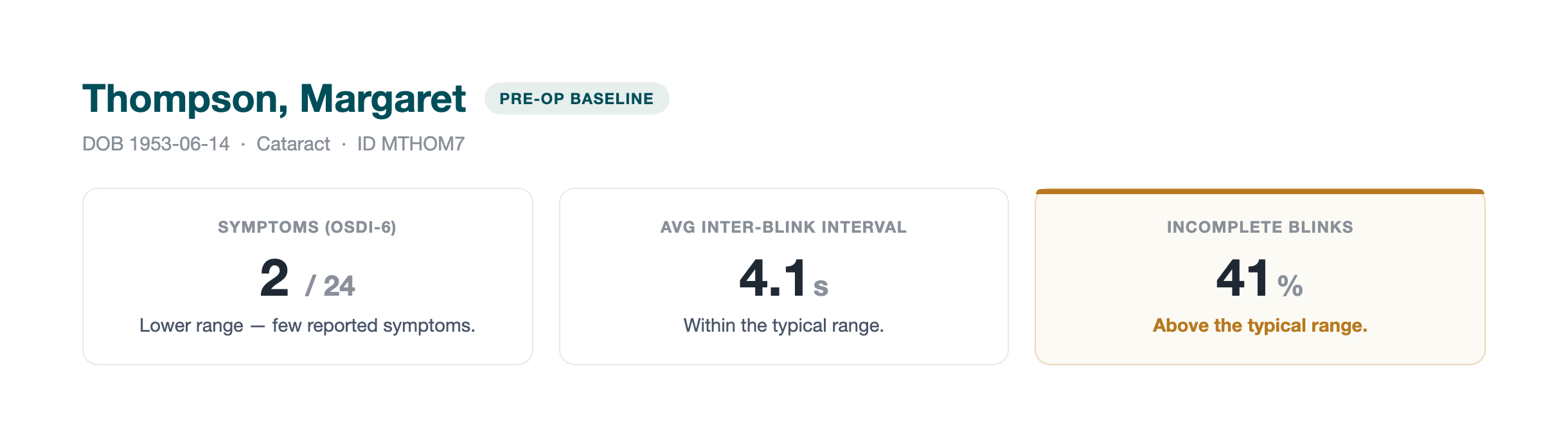
The patient reports almost no symptoms, but blink completeness is already flagged for clinical correlation, caught before surgery.
Most surgical patients have ocular surface disease. Most don’t feel it.
Up to 77% of routine cataract patients have an abnormal ocular surface, and many report no symptoms.1 Even among the asymptomatic, 85% still show an abnormal tear test.2 It’s easy to miss, and it matters. An unstable tear film degrades keratometry and IOL-power accuracy, most costly with premium lenses.3 Roughly 37% of previously normal eyes develop dry eye after surgery,4 so the patient who felt fine before and irritated after tends to blame the operation.
The evidence is sharpest in cataract, but the same unmanaged ocular surface undermines refractive outcomes too. Aqueo is the screening layer: a three-minute in-clinic check before and after the procedure to flag who warrants a closer look, and generates a pre-op baseline to track against post-op. It informs your judgment; it doesn’t diagnose or replace your exam.
How Aqueo fits into your workflow
Automated data collection
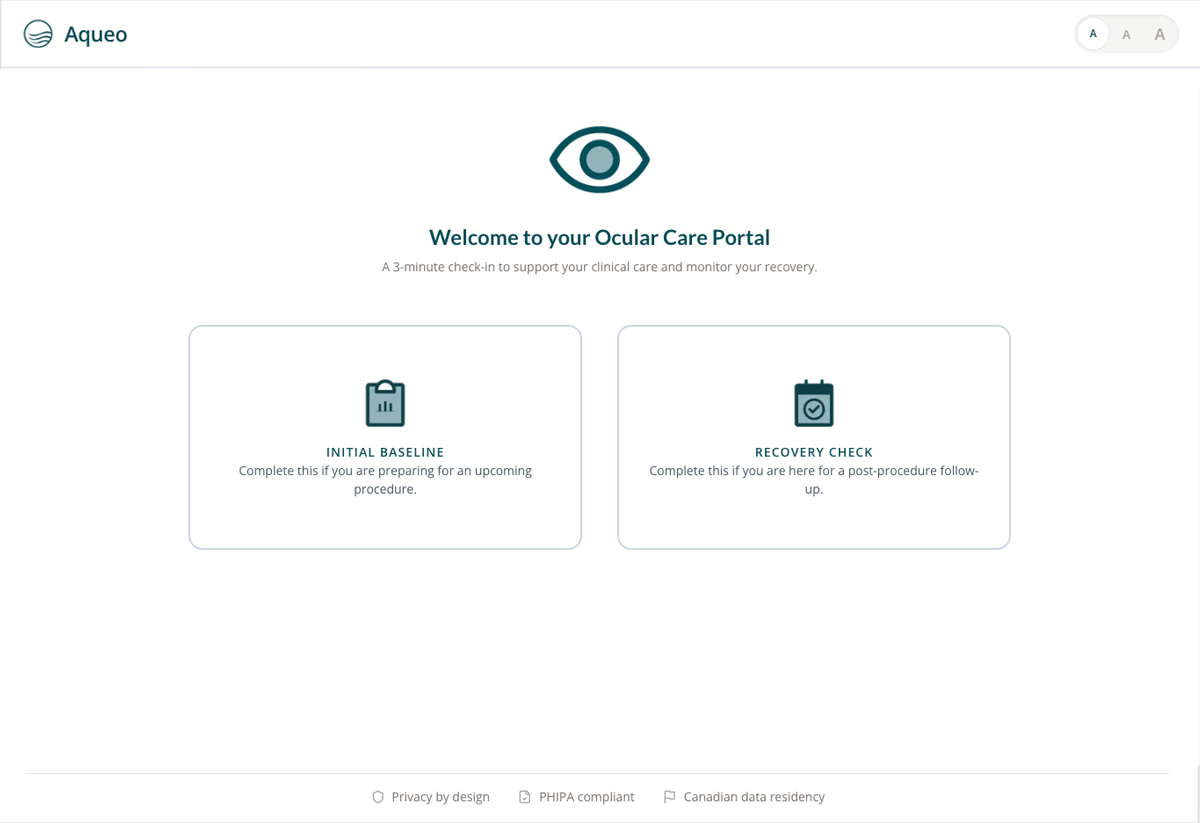
Whether preparing for a procedure or starting a chronic dry eye regimen, patients complete a structured symptom survey and guided blink test at the in-clinic kiosk.
Objective clinical metrics
Aqueo processes OSDI-6 responses and blink video to generate standardized symptom scores and precise blink metrics, establishing a clear pre-treatment baseline.
Proof of recovery
When patients return, Aqueo instantly compares their current metrics against their baseline. You get objective data showing exactly how their ocular surface is responding to treatment or recovering from a procedure.
Focused chair time
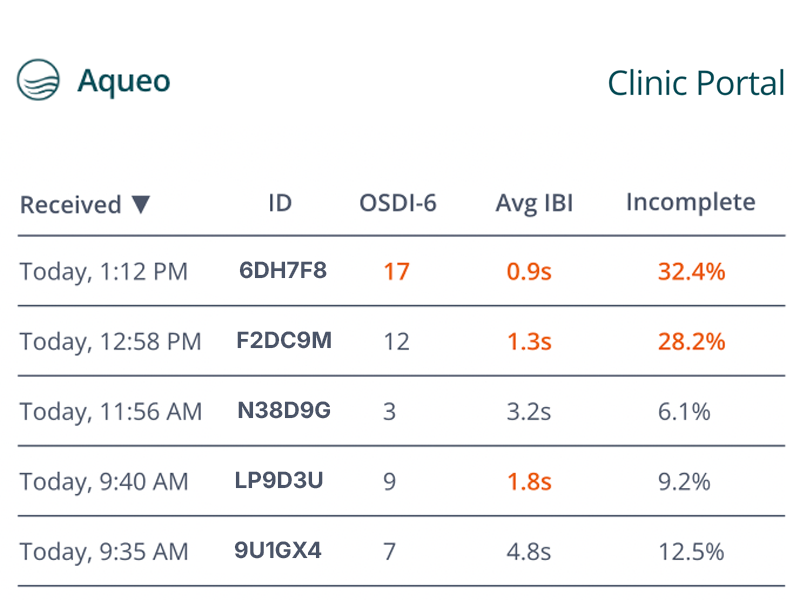
With data clearly visualized in your portal, you spend less time asking repetitive history questions and more time interpreting results and educating the patient.
The Patient Portal
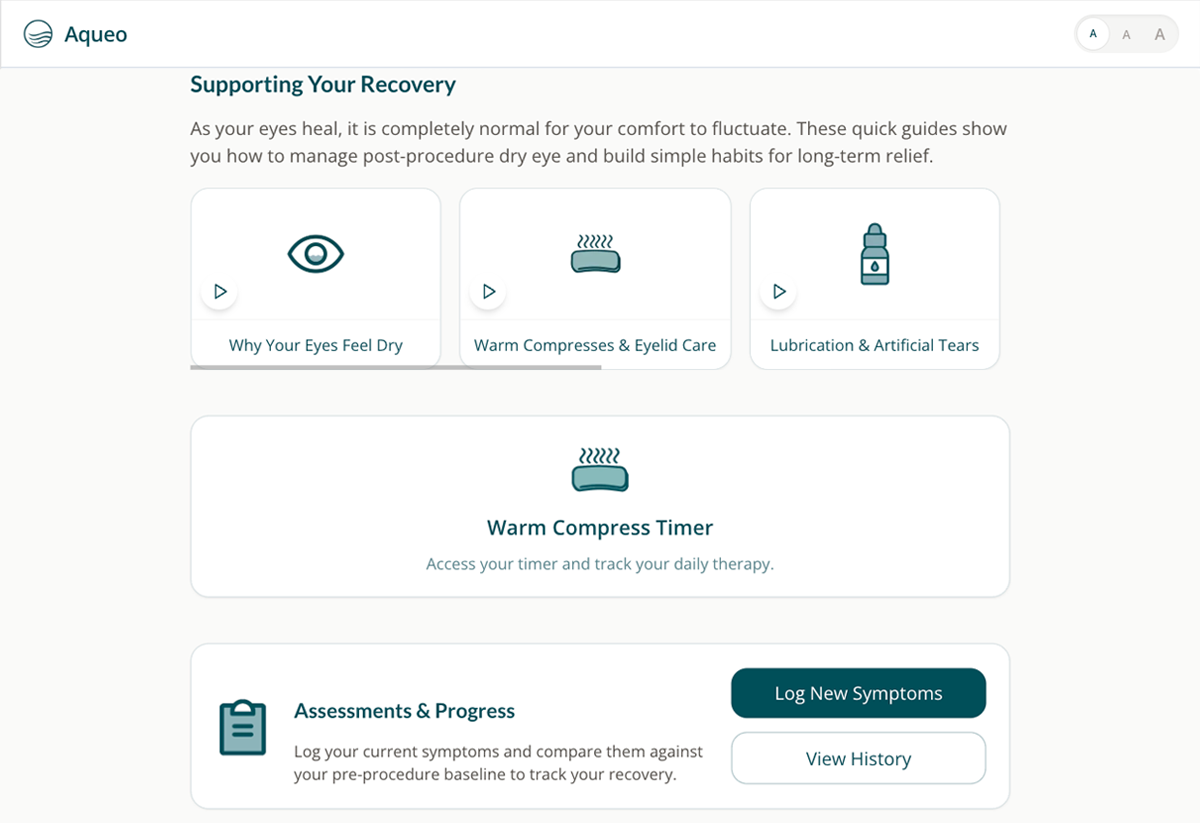
Patients leave the clinic with a secure link to their personal recovery dashboard. Aqueo takes the burden of routine education off your plate.
Driving compliance
With videos to help patients understand their condition and treatment options, and a customizable warm compress timer, Aqueo helps ensure patients actually follow your prescribed at-home care plan.
Clinical methodology & data security
Clinical Methodology
Aqueo's tracking engine is built on structured screening methods: the OSDI-6, a dry-eye symptom questionnaire recommended by TFOS DEWS III, and blink pattern analysis. These tools provide standardized symptom scores and objective blink metrics to support initial triage and track long-term recovery.
Data & Security
Aqueo is built with privacy and security by design for Canadian eye care. We minimize identifiers, encrypt data, and host exclusively in Canada.
- Canadian data residency – All clinical data is stored in AWS ca-central-1 (Canada Central).
- Clinic as HIC – Your clinic remains the Health Information Custodian. Aqueo operates as your authorized agent/service provider.
- Minimal data collection – Aqueo collects only what is needed for clinical workflow: patient name, date of birth, symptom scores, and blink metrics. No phone numbers, emails, or contact information.
- Encryption – All data is encrypted in transit (TLS) and at rest (SSE-KMS). Blink videos are stored in secured, access-controlled buckets with presigned URLs.
- Retention – Clinical data is automatically moved to long-term encrypted storage and deleted after approximately 10 years via S3 lifecycle policies, aligned with CPSO clinical record retention requirements, unless your clinic requests earlier deletion where appropriate.
- Contracts – Each clinic signs an Agent Agreement defining roles, responsibilities, retention, and breach notification procedures.
Get started
Aqueo is currently in a closed pilot with select Canadian clinics. If you're interested in seeing how Aqueo could support your dry eye workflow, we'd be happy to connect.